"AI agent" has become one of the most stretched terms in business software. Depending on who is selling, it can mean a chatbot, a set of automation rules, or a system that supposedly runs a department on its own. None of those descriptions helps you decide whether an agent would be useful in your business.
This article sets out what a custom AI agent is, what it can realistically do today, and how to recognize a task that suits one.
A working definition
An AI agent is software that reads a situation, decides on a next step within rules you set, and uses a small set of tools to carry out that step. The tools might be a search over approved documents, the ability to create a task in your CRM, or permission to draft (but not send) an email.
Three parts of that definition matter:
- Reads a situation. Agents work with varied, unstructured inputs: an email written in someone's own words, a support ticket, a form with a free-text field.
- Within rules you set. A useful agent has a defined job, a list of things it may do and a list of conditions that make it stop and ask a person.
- Uses tools. The agent does not just produce text. It takes actions through systems you already use, with permissions you control.
What agents do well
Agents are strongest where a task needs some judgment but follows a recognizable pattern.
Sorting and routing incoming work
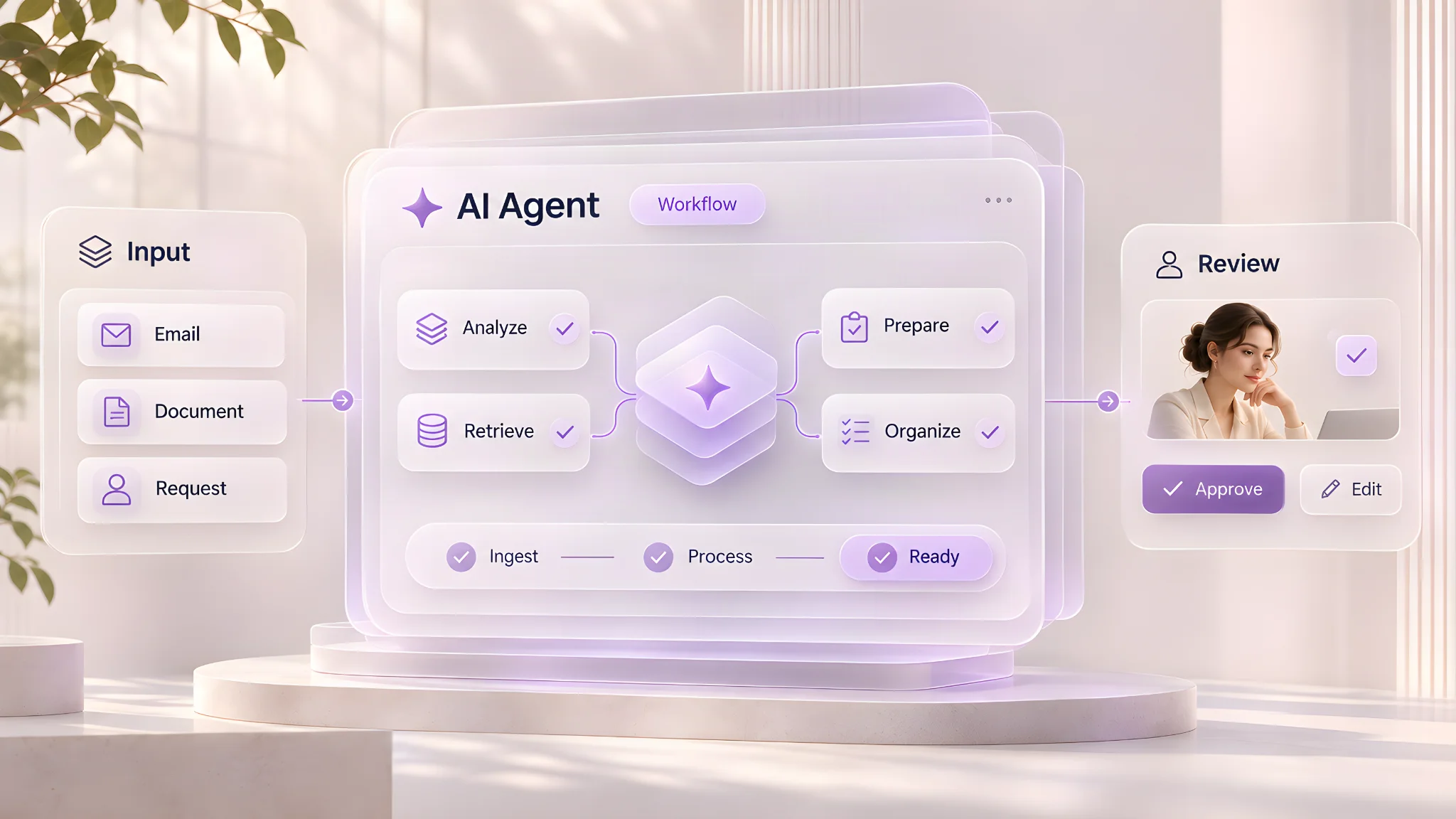
Requests arrive in many shapes. An agent can read each one, decide what kind of request it is, extract the key details and place it in the right queue with a one-line summary. The value is less in speed than in consistency: every request is handled the same way, and fewer requests are left unnoticed in a shared inbox.
Research over approved sources
Many questions inside a business are answered by checking the same few documents or systems every time. An agent can search those approved sources, return a short answer and show exactly which passages it relied on, so the person asking can verify it.
Preparing drafts for review
Replies, summaries and first-pass documents often follow a pattern. An agent can prepare a draft that a person edits and approves. This keeps a human in charge of anything that leaves the business while removing the blank-page effort.
Structured actions with approval
An agent can prepare a change, such as an account update or a new record, and place it in an approval queue. A person approves or rejects it with one click.
An illustrative example: handling a service inquiry
Imagine a small service company receives an email saying: “Our office needs help next week. Can someone explain the options?” The company has not authorized an AI agent to promise prices or book appointments.
A carefully scoped workflow could work like this:
- Intake: The system saves the message and gives it a tracking number.
- Interpretation: The agent identifies it as a new project inquiry and extracts the service requested, desired timing and missing details.
- Approved lookup: It checks the company's published service descriptions, not private records it has no permission to access.
- Proposed action: It drafts a clarification question and prepares a task for the sales coordinator.
- Human review: A staff member decides what to send and whether a consultation can be offered.
This is a hypothetical example, not a claim about a deployed Alaysalee client system. Notice that automation handles intake and tracking, while AI handles the unclear language and a person controls the commitment.
Where agents fall short
Being clear about limits is what makes agents safe to use.
- They can be wrong. Language models sometimes produce confident but incorrect output. Good designs assume this and route uncertain or risky cases to a person.
- They need boundaries. An agent with broad permissions and vague instructions is unpredictable. Narrow jobs produce reliable results.
- They are not a substitute for accountability. Decisions with legal, financial, medical or employment consequences should stay with a person.
- They need good inputs. If the information an agent relies on is outdated or contradictory, its answers will be too.
A checklist for spotting a good first task
A task is a strong candidate for a first agent when most of these are true:
- It happens often enough that saving time on it matters.
- Inputs vary, so a simple rule cannot handle it.
- You can show examples of correct and incorrect outcomes.
- The systems involved can be reached through an API, an export or an integration.
- A wrong draft is low-risk because a person reviews it.
- Someone on your team can review edge cases during a pilot.
If a task is completely predictable, plain automation is usually cheaper and more reliable. If it is high-stakes and no one wants to review it, it is not ready for an agent.
What a responsible agent project includes
A first agent is best treated as a focused pilot. It should include a written task definition, a set of test examples, narrow permissions, an approval step for anything that matters, logs of every run and a simple way to switch the agent off. Data handling, including which AI provider sees which information, should be agreed before any real data is used.
Questions business owners often ask
Do AI agents need access to all our business data?
No. Start with the minimum information and tool permissions needed for one task. Sensitive information should be excluded unless there is a justified, documented reason to use it.
Can an agent send messages or update records automatically?
Technically, some can. Whether it should depends on the action's consequences and the reliability demonstrated during testing. A practical pilot often begins with drafts and approvals.
How will we know whether an agent is worth it?
Choose a baseline before building: time spent reviewing inquiries, routing mistakes, correction rates or the number of items requiring escalation. Compare the pilot to that baseline, including maintenance and model usage costs.
Where to go from here
If you have a task in mind, write down where its inputs come from, what a good outcome looks like and who checks the result today. That short description is usually enough to judge whether an agent fits.
Read more about how we approach custom AI agent development, or start with an AI readiness assessment if you are not yet sure which task to begin with.