1. Home
  2. AI & Technology
  3. Custom AI Agent Development

Custom AI agent development

Custom AI Agents Built Around a Defined Job

We design and build AI agents that handle one clearly scoped piece of work inside your business: reading a request, checking approved information, preparing an action and handing it to a person when the rules say so. Every agent has written boundaries, narrow permissions and a log you can review.

Clear definitions

An agent is not a chatbot, and it is not magic

An AI agent is software that reads a situation, decides on the next step within rules you set, and uses a small set of tools to carry that step out. The useful ones are narrow: they do one job well, know when to stop and leave a clear record of what they did.

That is different from a chatbot, which mostly answers questions, and from rules-based automation, which follows fixed steps without interpreting anything. Many good solutions combine all three. We start by deciding which parts of your task truly need judgment and keep everything else simple and predictable.

  1. Chatbot

    Answers questions in a conversation. Useful for information, but it does not carry out work in your systems on its own.

  2. Rules-based automation

    Moves data through fixed steps: if this, then that. Reliable and cheap when inputs are predictable. See workflow automation.

  3. AI agent

    Interprets varied inputs, chooses among permitted actions and uses tools such as a CRM or a document store, within boundaries and with approval gates.

  4. “Autonomous” agent

    Marketing language for an agent with few limits. We do not build agents that take irreversible actions without a person’s approval.

One request, five checkpoints

Illustrative
  1. Intake Input

    New request from the website form

    “Need a quote for 40 branded tote bags by March 14.” Classified as: quote request · medium priority.

  2. Approved data Agent

    Reads the price sheet and lead-time policy

    Read-only access to two documents the team approved. No access to invoices, payroll or email.

  3. Proposed action Agent

    Drafts a reply and a CRM task

    Draft cites the lead-time policy. Flags that the requested date is tighter than the standard window.

  4. Human approval Person

    Sales lead reviews and edits the draft

    Nothing is sent until a person approves. The agent cannot change prices or promise dates.

  5. Logged result Logged

    Reply sent by the team; task created

    Inputs, sources, draft, edits and approver saved to the audit log.

Illustrative task canvas with a fictional business and request. It shows how an agent’s work is bounded; it is not a deployed system.

The problem

Work that needs judgment, but follows a pattern

Agents earn their place where a task is too varied for a simple rule and too repetitive to deserve a skilled person’s full attention.

  1. Requests that need sorting before anyone can act

    Inquiries, orders and internal asks arrive in different shapes. Someone reads each one, works out what it is and decides where it goes.

  2. Research that repeats the same lookups

    Answering a question means checking the same three systems or documents every time, then summarizing what was found.

  3. Drafts that start from a blank page

    Replies, summaries and first-pass documents follow a pattern, yet each still takes time to prepare from scratch.

  4. Hand-offs that depend on someone remembering

    A task finishes in one tool and the next step waits until a person notices and moves it along.

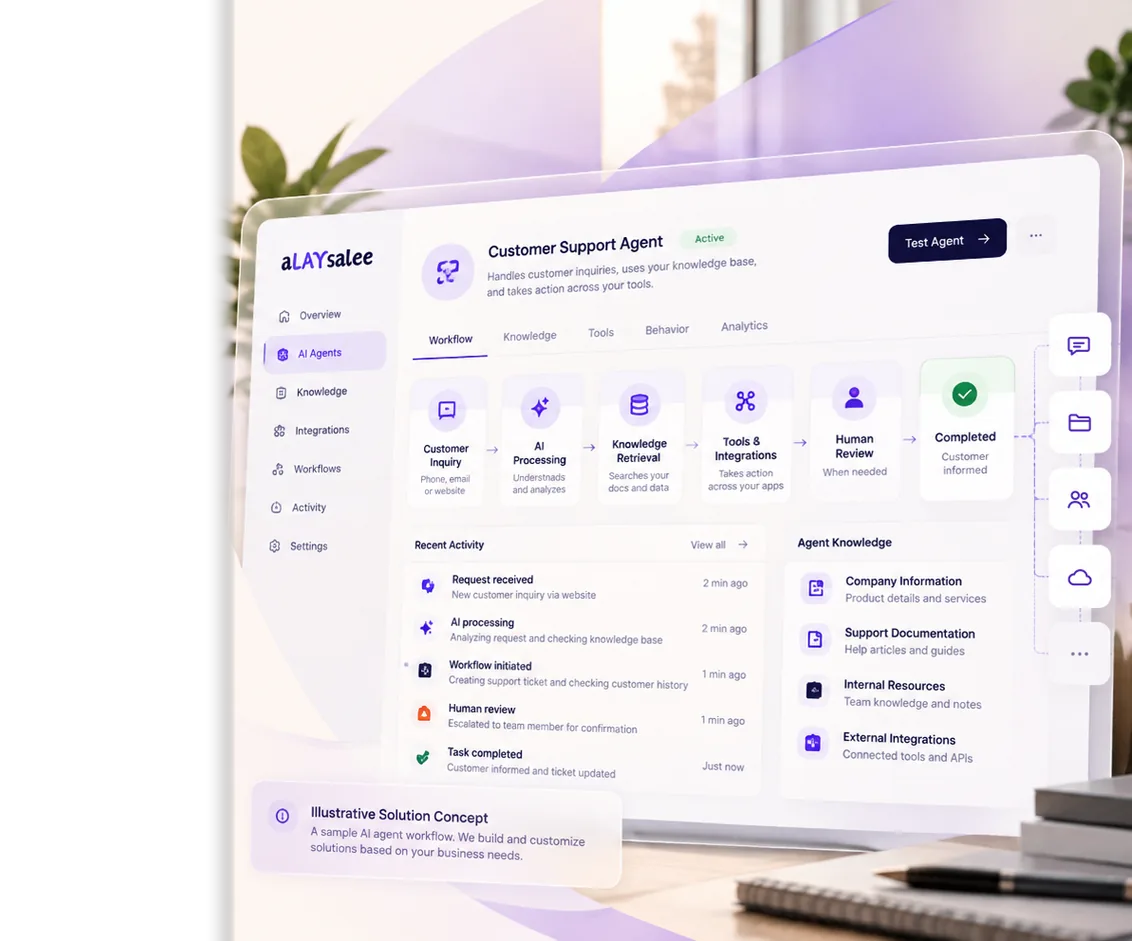
Illustrative dashboard for a customer support AI agent: a workflow from customer inquiry, AI processing, knowledge retrieval and connected tools to human review and a completed task, with a recent-activity log.
Illustrative Solution Concept. A sample AI agent workflow. We build and customize solutions based on your business needs.

Example scenarios

What a well-scoped agent could look like

Fictional examples to show scope and boundaries. They are not Alaysalee clients, deployments or measured results.

Example · Inquiry classification

Situation

A regional services firm receives 60–80 web inquiries a week across five service lines, and a coordinator sorts them by hand each morning.

What would be built

An agent reads each inquiry, assigns a service line and urgency, extracts the contact details and the key facts, and creates a record in the right queue with a one-line summary.

A person stays involved

Low-confidence classifications and anything mentioning a complaint go to the coordinator unsorted. Staff can re-classify in one click, and corrections are reviewed weekly.

Example · Internal research with approved sources

Situation

An operations team answers recurring supplier questions by searching contracts, a policy folder and past emails.

What would be built

An agent searches only the approved contract and policy folders, returns a short answer with links to the exact clauses it used, and says when it found nothing relevant.

A person stays involved

The agent never contacts suppliers. A team member reads the cited sources before replying.

Example · Ticket triage with approval

Situation

An IT support desk wants routine password and access requests prepared faster.

What would be built

An agent checks the requester against the directory, prepares the standard change and drafts the reply, then places both in an approval queue.

A person stays involved

A technician approves or rejects each change. The agent has no permission to execute changes itself.

Capabilities and limits

What an agent can do, and where it should stop

Can be set up to

  • Classify and route incoming requests using your categories
  • Read from approved documents and systems with read-only access where possible
  • Draft replies, summaries and records for a person to review
  • Call a small set of permitted tools, such as creating a CRM task
  • Ask a person for a decision when it is uncertain or the case is sensitive
  • Record every input, source, decision and action

Does not, by design

  • Take irreversible financial, legal, medical or employment actions without human approval
  • Invent prices, policies or commitments that are not in its approved sources
  • Guarantee correct answers: language models can be wrong, so outputs are checked
  • Access systems or data beyond the permissions agreed in writing
  • Replace the people accountable for the outcome

Trust, security and oversight

Controls are part of the design, not an add-on

Before an agent touches real data, we agree in writing what it may read, what it may do and who reviews it.

  • Narrow permissions

    Each agent gets its own credentials with the least access the job needs, so it cannot wander into unrelated systems.

  • Approval gates

    Actions that affect customers, money or records outside the agreed scope wait for a named person to approve them.

  • Grounded answers

    Where an agent explains or drafts, it works from approved sources and shows which ones it used. If the answer is not there, it says so.

  • Evaluation before rollout

    We test against realistic and awkward cases, including ones the agent must refuse, before it handles live work.

  • Logs and an off switch

    Every run is logged, and the agent can be paused without breaking the rest of your process.

  • Data handling agreed up front

    Which data reaches which AI provider, where it is stored and how long it is kept is decided before the build, not after.

Scope and deliverables

What an agent engagement includes

A first agent is usually a focused pilot. The exact scope is written down before work starts.

  1. Task definition

    The job, inputs, permitted actions, stop conditions and what “done” means, agreed in writing.

  2. Evaluation set

    Real or realistic examples, including edge cases, used to measure quality before and after launch.

  3. The agent and its tools

    Prompting, retrieval, tool connections and guardrails, built and tested against the evaluation set.

  4. Review interface

    Where people approve, edit or reject the agent’s proposals: often your existing tool, sometimes a small queue we build.

  5. Logging and monitoring

    A record of each run and alerts when errors or unusual patterns appear.

  6. Handover documentation

    How the agent works, how to change its instructions and how to switch it off.

Readiness

Before we start building

You do not need everything ready, but these make a first agent far more likely to succeed. If you are unsure, an AI consulting engagement can establish them first.

  • A specific, repeated task rather than a general wish to “use AI”
  • Examples of real inputs and the outcomes you consider correct
  • Access to the relevant systems through an API, export or supported integration
  • A person who can review edge cases during the pilot
  • Agreement on which data may be processed by which AI provider

Fit

Is an agent the right tool?

A good fit when you have

  • A repeated task with a clear definition of “done”
  • Access to the systems involved through an API or export
  • Someone who can review edge cases during the pilot

Probably not a fit when

  • The task is fully predictable: plain automation will be cheaper and more reliable
  • The work involves irreversible decisions no one is willing to review
  • There are no examples of what a good outcome looks like
  • The goal is to remove human accountability rather than reduce repetitive effort

Engagement approach

From one task to a working pilot

Timing depends on the task, the systems involved and how quickly examples and access can be provided, so we estimate it after discovery.

  1. Task definition

    We agree the job, the inputs the agent may read, the actions it may take and the conditions that stop it.

  2. Evaluation set

    We collect real or realistic examples, including awkward ones, and define what a correct outcome looks like.

  3. Build with guardrails

    Tools, retrieval and instructions are connected with the narrowest permissions available and approval gates for anything that matters.

  4. Controlled pilot

    The agent works on low-risk cases while your team reviews its proposals and logs.

  5. Improve and widen

    Instructions and scope change only when review results support it.

Questions

Questions about custom AI agents

Something else on your mind? Ask us directly

What data will the agent be able to access?

Only what the task needs and what you approve in writing. We prefer read-only access, dedicated credentials and a short list of permitted actions. Access is documented so you can review or revoke it at any time.

What happens when the agent gets something wrong?

Language models can produce confident but incorrect output, so agents are designed around that. They work from approved sources, say when they are uncertain, send risky or ambiguous cases to a person and log every step. Errors found during review are used to improve the instructions and the evaluation set.

Can it work with the software we already use?

Usually, if the software offers an API, a webhook, an export or a supported automation connection. We confirm this during discovery before recommending anything. Where no connection exists, the agent can work through a review queue instead.

What is a sensible first project?

One task that happens often, has clear examples of good and bad outcomes and carries limited risk if a draft is wrong, because a person reviews it. Classification, research with citations and draft preparation are common starting points.

Can the agent take actions on its own?

Within agreed limits. Low-risk, reversible actions, such as tagging a record or creating a task, can run without approval once testing supports it. Anything that affects customers, money or commitments goes through an approval step.

How is an agent monitored after launch?

Through its logs, periodic review of a sample of runs and alerts for errors or unusual volumes. When a model or your process changes, the evaluation set is re-run before the change goes live.

Next step

Have a task you suspect an agent could handle?

Describe the task, where its inputs come from and who checks the result today. We will tell you whether an agent fits, what a pilot would involve and when simpler automation is the better answer.

We reply by email. An inquiry is not a contract, and there is no obligation.

Start a Conversation

We use these details only to reply to your inquiry. Nothing is shared or used for marketing. Privacy Policy

What is this about?

At least 20 characters.